Gamification and learning
What can a virtual ocean teach?
Movement, feedback and discovery can support an encounter with ocean science. Learning still depends on the choices within the experience.
SEAing Breath archive editorial3 min read
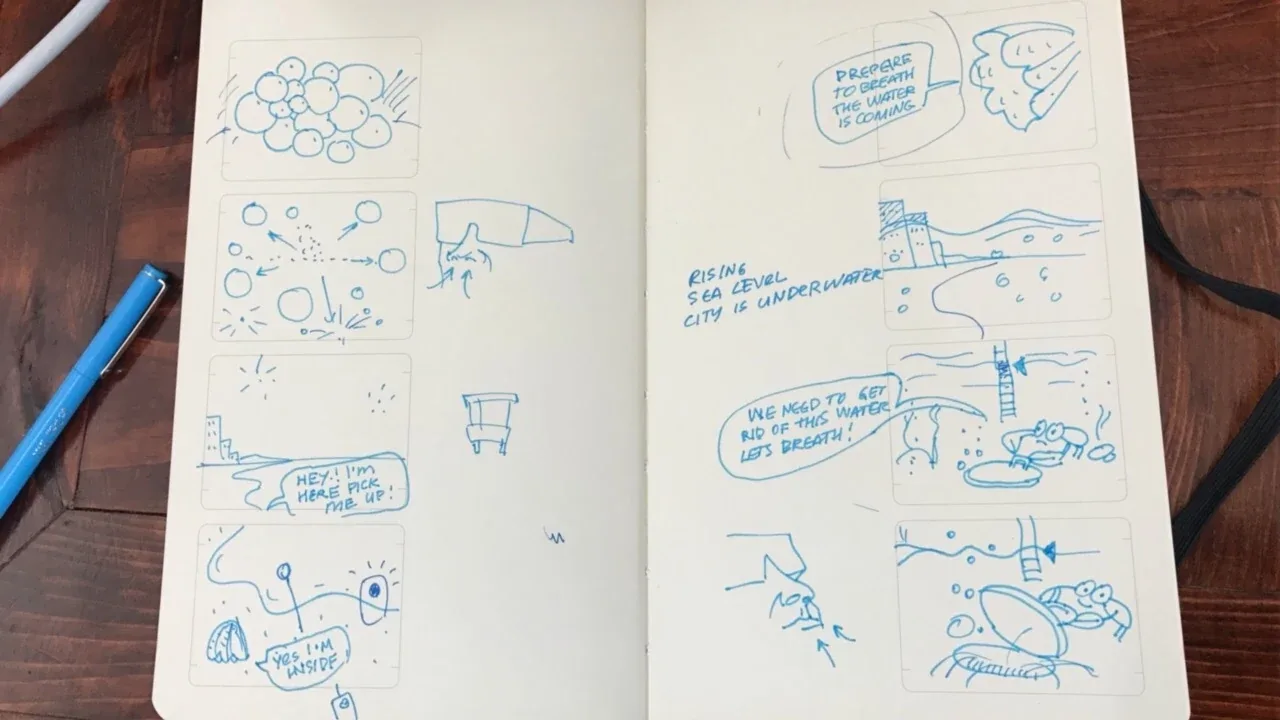
A meaningful action
A breath changes the water level. A creature responds. A visitor tries again and watches the result. SEAing Breath’s game-like interaction gives an ordinary bodily action a visible consequence. The design question is what that relationship helps a visitor understand and what explanation or reflection should follow it.
Gamification in this setting can be discussed through goals, rules, feedback and progress. The useful unit is a relationship between an action and an idea. An interaction earns its place when a visitor can connect what they did with what they discovered.
Learning has several measures
Markowitz and colleagues reported four studies in 2018 involving more than 270 participants exploring an underwater VR environment about ocean acidification. The studies found knowledge gains or interest in further learning, with some changes in attitudes. Ocean acidification and sea-level rise are distinct processes. The research provides a relevant example of immersive ocean education, with outcomes specific to those studies. [1]
A 2024 meta-analysis of 40 VR science and education studies reported positive average learning outcomes and substantial variation across studies. The differences between designs and settings matter when interpreting an average. [2]
A preregistered field study published in 2023 ran across 17 museums, aquariums and other venues in four countries. In that ocean-acidification experience, increased body movement raised self-efficacy while hindering learning. Feeling able to act and retaining an explanation can move in different directions within the same design. [3]
Research in 2025–2026
Ditrich and Lachmair’s experiment, published online in February 2025, compared responses to a report about rising seas in Fiji viewed through a headset or on a computer screen. Among 146 participants, the headset condition produced greater perceived presence. Pro-environmental intentions did not differ between conditions. Presence correlated with intentions and sympathy, adding a reason to examine how a feeling of being there relates to the outcomes an experience is intended to support. [4]
A 2026 study by Santoso and colleagues examined ocean VR in a different physical setting. Ninety-four participants were randomly assigned to experience the same ten-minute ocean content on the ground, in water with contact to a support, or floating. The floating condition showed higher ocean connectedness than the other conditions. These findings concern that experimental setting and its measured outcomes. They offer another question for embodied ocean learning, about how the physical setting and the virtual scene interact. [5]
Questions for an ocean experience
Three questions follow for a contemporary presentation of SEAing Breath. Can a visitor describe the feedback loop? Can they connect the virtual waterline to an accurately framed environmental question? Can they identify a real source where they can learn more?
These questions suggest an experience with room for exploration, a concise explanation and a moment of reflection. They also suggest multiple ways to assess the encounter. Visitor enjoyment, perceived agency, factual understanding and later curiosity each deserve a clear name.
The original storyboards reveal decisions about pacing, narrative and the connection between breathing and environmental change. The visitor interviews preserve responses from public presentations. Together they provide material for discussing gamification as an artistic and educational design practice. Later research can sharpen the questions asked of a future version, while the original records retain their historical place.
Sources
- 1.
Markowitz et al., Frontiers in Psychology · 30 November 2018
Immersive Virtual Reality Field Trips Facilitate Learning About Climate Change ↗ - 2.
Frontiers in Psychology · 2024
Design strategies for VR science and education games from an embodied cognition perspective ↗ - 3.
Queiroz et al., Sustainability · 2023
The Efficacy of Virtual Reality on Climate Change Education Increases with Amount of Body Movement and Message Specificity ↗ - 4.
Lara Ditrich and Martin Lachmair, Environmental Education Research · 4 February 2025 (published online; 2026 journal volume)
A ‘front-row seat’ to catastrophe: testing the effect of immersive technologies on sympathy and pro-environmental behavior in the context of rising sea levels ↗ - 5.
Monique Santoso, Gustav Bøg Petersen, Jeremy N. Bailenson and Géraldine Fauville, Journal of Environmental Psychology · 2026
Underwater virtual reality and situated cognition: Comparing ground, docked, and floating conditions for ocean connectedness and psychological wellbeing ↗