Biofeedback and interaction
When breathing changes the virtual world
Later research asks what immersion and real physiological feedback contribute to an experience shaped by breathing.
SEAing Breath archive editorial2 min read
A signal becomes part of the scene
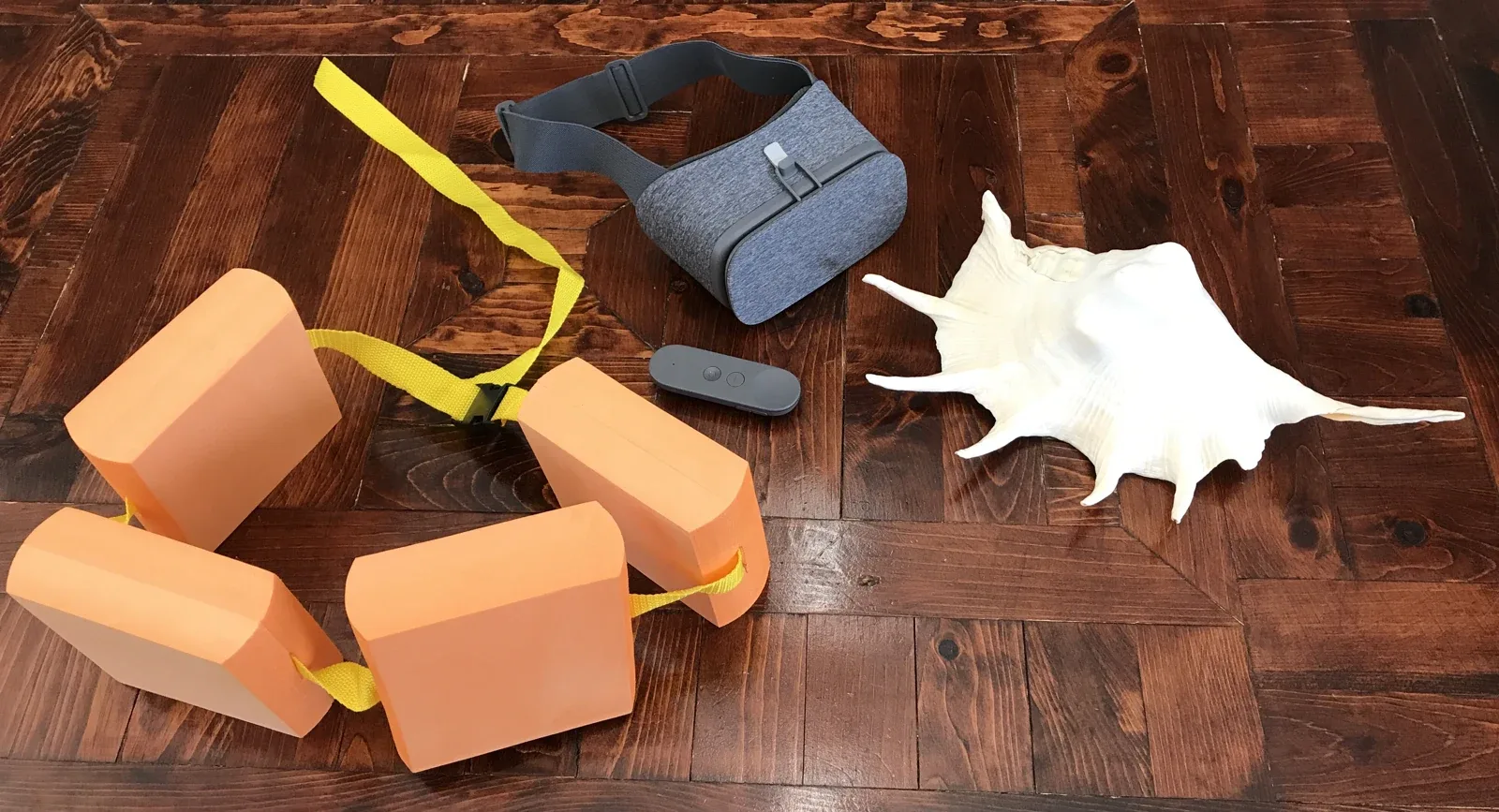
In SEAing Breath, respiration supplies an input to the virtual environment. A headset, a sensor and a responsive scene form a loop that the visitor can experience through their own body. The 2017 prototype films make this translation visible, from experiments with an airflow sensor to a swim belt and a working scene.
That relationship remains an active research subject. Designers now ask how feedback, immersion, guidance and personalisation contribute to a breathing experience. These are distinct design choices. A visually enveloping scene can feel different from a screen, and a scene responding to actual breathing poses a different question from one following a fixed animation.
What later reviews found
A systematic review published in 2024 by Cortez-Vázquez and colleagues included six randomised trials with 469 adults. It found no clear added advantage of VR breathing interventions over comparable breathing interventions delivered outside VR for the assessed mental-health and physiological outcomes. The quality of evidence varied. The review gives a reason to examine what a particular system adds and how its effects are assessed. [1]
A 2025 scoping review by Pancini, Di Natale and Villani mapped 18 studies. It described several uses of VR for breathing guidance, feedback and personalised environments, alongside substantial variation in methods and open questions for further research. Mapping a growing field shows the range of approaches. Comparisons and longer follow-up are needed to understand their effects. [2]
Returning to an artwork
For an art archive, the productive connection is the design question. What does a visitor notice when the environment answers a rhythm they usually overlook? How legible is the connection between a breath and a change in the scene? What can a visitor explain after removing the headset?
SEAing Breath’s public documentation records an artistic and educational encounter. The later studies concern systems and populations described in their own publications. Reading the two together allows an informed discussion of breath as an interface while keeping each record tied to its actual evidence.
The original setup walkthrough, sensor tests and visitor interviews offer unusually concrete material for that discussion. They show the apparatus, the feedback and the public response from different viewpoints. A contemporary reconstruction could use those records to define new questions and measures before making claims about a new version.
Sources
- 1.
Cortez-Vázquez et al., Applied Psychophysiology and Biofeedback · 18 January 2024
Virtual Reality Breathing Interventions for Mental Health ↗ - 2.
Pancini, Di Natale and Villani, Virtual Reality · 27 January 2025
Breathing in virtual reality for promoting mental health ↗